

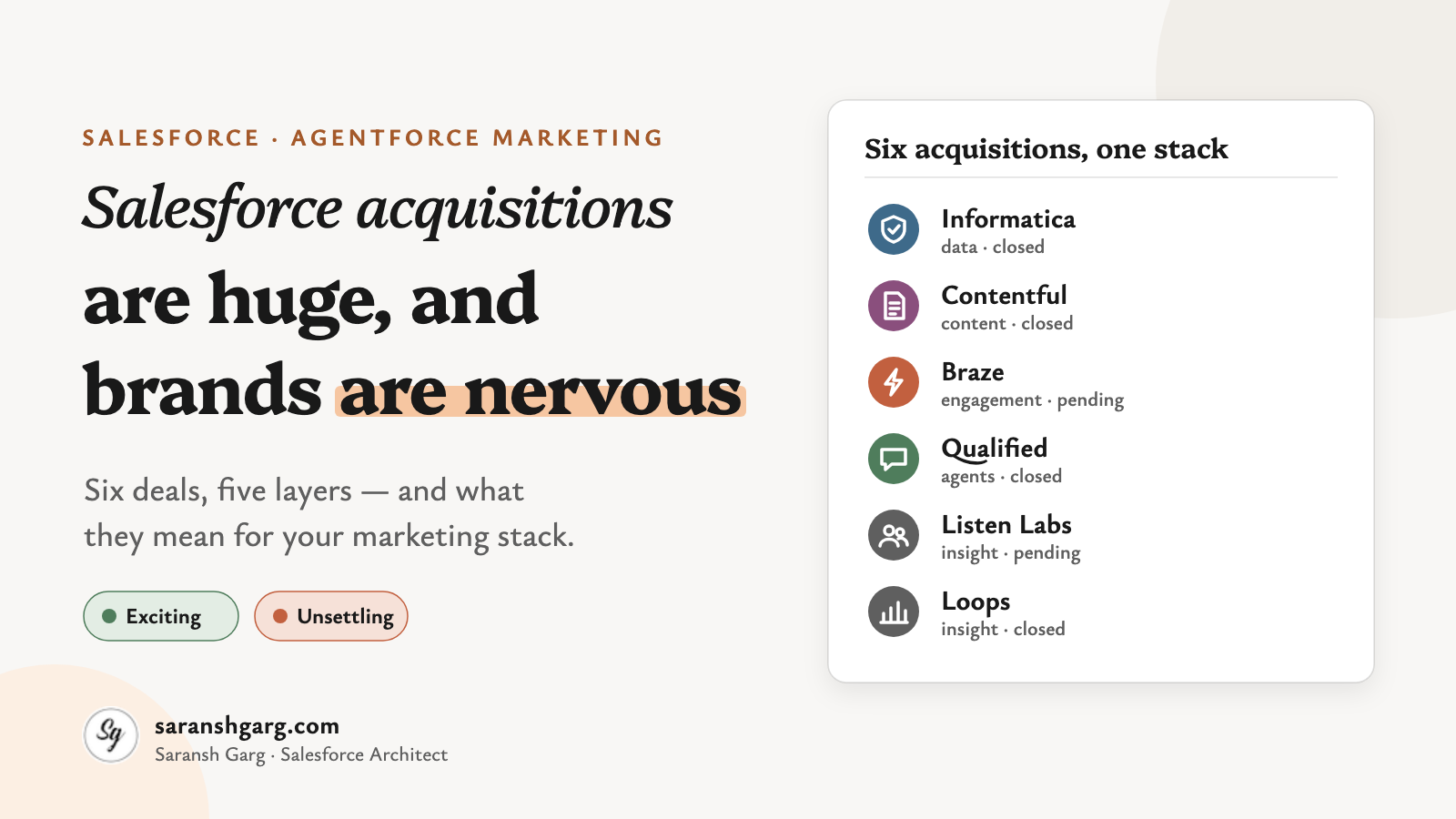
Informatica. Qualified. Contentful. Listen Labs. Loops. And now Braze.
That’s six Salesforce acquisitions in about a year that touch marketing directly. And that’s before counting the service and billing deals that landed in between.
Cool, right? It’s certainly exciting if you build on the platform.
But in client conversations I keep hearing a different reaction. It’s less “wow” and more:
“We’ve only just moved to Marketing Cloud Next. What happens to our setup if the stack changes again?”
That’s a fair worry. So let’s look at the pieces properly: what each acquisition brings, where it fits in the Salesforce ecosystem, and what it changes for developers, marketers and brands.
Let’s get into it.
Salesforce acquisitions in a nutshell
- Informatica (closed Nov 2025): data integration, quality, governance and MDM under Data 360.
- Qualified (closed Apr 2026): Piper, an AI SDR agent that turns website visitors into pipeline.
- Contentful (closed Sep 2026): a headless content layer that agents and journeys can assemble from.
- Listen Labs (signed Sep 2026): AI-run customer research and interviews.
- Loops (closed Nov 2026): AI analytics in Tableau that explains why a metric moved.
- Braze (signed Oct 2026, closes FY28): real-time, mobile-first engagement and AI decisioning.
First, the stack these acquisitions plug into
If you’ve followed the renames, you’ll know this is a moving target. Marketing Cloud is now sold under the Agentforce Marketing banner. Data Cloud became Data 360. Marketing Cloud Next sits alongside Engagement and Account Engagement, which still serve existing customers.
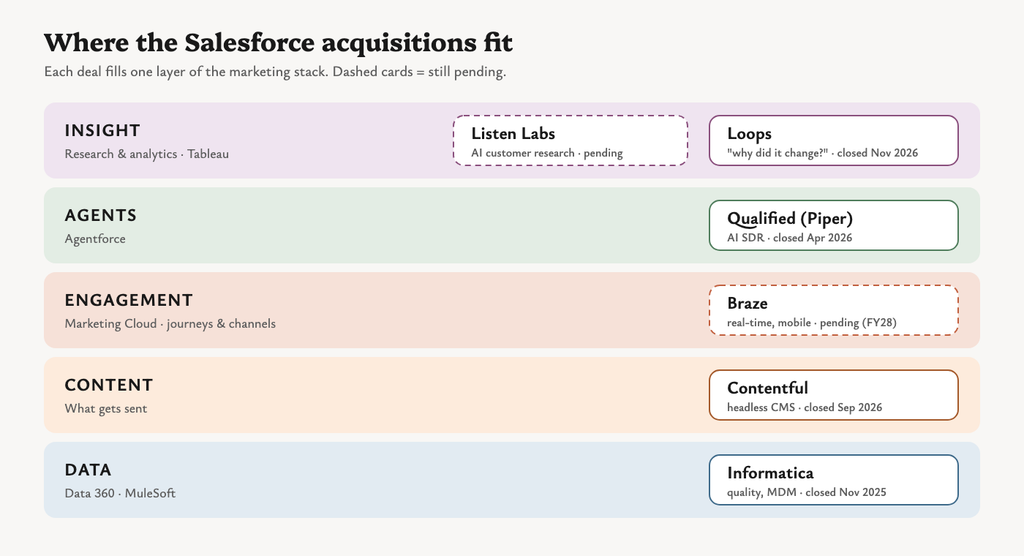
So here are the layers I’ll use for the rest of this post:
- Data — Data 360, where profiles are unified and governed.
- Content — what gets sent: copy, images, product content.
- Engagement — journeys and channels: email, SMS, push, in-app, web.
- Agents — Agentforce, doing the work on top of everything else.
- Insight — research and analytics: what customers think, and what happened.
Every one of these Salesforce acquisitions fills one layer. That’s the pattern worth seeing.
Informatica: the data foundation
Of all the recent Salesforce acquisitions, this was the big one by price, about $8 billion in equity value, and it closed first.
What it brings: data catalog, integration, data quality, governance, privacy and master data management. Salesforce described it as “a unified and comprehensive data foundation for agentic AI”. Where it fits: underneath Data 360, alongside MuleSoft for integration. Developers: fewer custom pipelines to clean and match data before it reaches Data 360. Marketers: cleaner profiles mean segments you can actually trust. Brands: if you already run Informatica MDM, it’s now inside the same vendor relationship. Helpful, but worth checking how your contracts change.
Example scenarios
- A retailer using Informatica MDM as the golden customer record, with Data 360 referencing it for activation.
- A bank applying the same data-quality rules before any profile is used in a campaign.
Qualified: pipeline from the website
Qualified brings Piper, an AI SDR agent. Salesforce announced the deal in December 2025 and closed it in April 2026.
What it brings: an agent that greets inbound website visitors, qualifies them and books meetings. Where it fits: B2B marketing and sales, on top of Agentforce. Salesforce’s own case study says it launched Piper on salesforce.com in 30 days. Developers: another agent to connect to CRM data and your existing routing rules. Marketers: the website becomes a pipeline channel, not just a form. Brands: be ready for overlap. Salesforce now has both Piper and Agentforce SDR, and you’ll need to understand which one Salesforce expects you to use.
Example scenarios
- A SaaS company’s pricing page where Piper qualifies visitors and books a demo there and then.
- An event follow-up where Piper picks up visitors who clicked through from a campaign email.
Contentful: the content layer
Now this one is particularly interesting for anyone who has fought with content in Marketing Cloud.
Salesforce completed the Contentful acquisition on 1 September 2026.
What it brings: a headless, API-first content platform. Salesforce says agents will be able to “query, assemble, and deliver content dynamically without manual publishing steps”. Where it fits: the content source for Agentforce Marketing journeys and personalisation, plus commerce and web. Developers: structured content models instead of copy pasted into templates. Marketers: one approved source of content across email, web and app. Brands: Salesforce already has Salesforce CMS and Experience Cloud content. Which one is the long-term home? That’s not fully clear yet.
Example scenarios
- A travel brand that writes a destination guide once, then reuses it in emails, the app and the website.
- An agent building a personalised product email from approved content blocks, with no manual copy-paste.
Listen Labs: research at agent speed
This is the one most people missed, and it’s quietly important for marketers.
Salesforce signed the agreement in September 2026. It’s expected to close in Q4 of fiscal 2027.
What it brings: AI agents that design studies, recruit participants, run interviews and analyse the results, plus “digital twins” that simulate customer behaviour. Where it fits: Salesforce AI Labs. Salesforce plans to bring it into Marketing Cloud, Service Cloud and Agentforce. Developers: little to build for now. The interesting part will come when research results feed Data 360. Marketers: you can test a message with real customers in days, not weeks. Brands: a big question for research and insight teams: how much do you trust a simulated customer?
Example scenarios
- Testing three campaign concepts with 200 real customers before the creative is locked.
- Asking lapsed subscribers why they left, then feeding the themes into a win-back journey.
Loops: the “why” behind the numbers
Loops is the smallest of these Salesforce acquisitions, and it closed on 2 November 2026.
What it brings: AI analytics that monitors business metrics and identifies what caused them to change. Where it fits: inside Tableau, not as a standalone product. Developers: fewer one-off dashboards built to answer “what happened last Tuesday?” Marketers: campaign performance explained, not just reported. Brands: easier to judge which channels and campaigns actually earn their budget.
Example scenarios
- Conversion drops 12% overnight and Tableau points to one broken email link in a single market.
- A loyalty team sees which segment drove an uplift without waiting for a monthly analysis.
Braze: real-time engagement
The headline deal: about $5.66 billion, announced on 20 October 2026. It’s expected to close in Salesforce’s fiscal year 2028, subject to shareholder and regulatory approval.
What it brings: event-streaming, mobile-first engagement and AI decisioning. Salesforce says Braze will complement all four layers of its architecture: Data 360, Customer 360, Agentforce and SIForce. Where it fits: engagement, especially in-app, push and real-time journeys. Developers: the Braze SDK in mobile apps, and event streams into and out of Data 360. Marketers: journeys that react while the customer is still in the app. Brands: Salesforce will soon own two engagement engines. Which one should your journeys run on?
I’ve covered Braze in depth in Braze brings Salesforce its hidden real-time edge, so I’ll keep this short.
Example scenarios
- A food delivery app nudging an abandoned basket in the same session, not the next morning.
- A bank sending a lock-screen update the moment a payment clears.
Salesforce acquisitions side by side
| Acquisition | Status | Layer | Biggest change for developers | For marketers | For brands |
|---|---|---|---|---|---|
| Informatica | Closed Nov 2025 | Data | Less custom data cleaning | Trustworthy segments | Contract consolidation |
| Qualified | Closed Apr 2026 | Agents | Agent wired to CRM routing | Website as a pipeline channel | Piper vs Agentforce SDR overlap |
| Contentful | Closed Sep 2026 | Content | Structured content models | One content source everywhere | Which CMS is the long-term home? |
| Listen Labs | Pending | Insight | Research data into Data 360 (later) | Faster customer research | Trust in simulated customers |
| Loops | Closed Nov 2026 | Insight | Fewer one-off dashboards | Performance explained | Clearer budget decisions |
| Braze | Pending (FY28) | Engagement | SDKs and event streams | Real-time, in-app journeys | Two engagement engines |
Alongside these, Salesforce also agreed to buy Fin (service automation), Cresta (voice AI for contact centres) and m3ter (usage-based billing). They aren’t marketing deals, but they’ll sit next to your marketing stack.
So, what does this mean for each group?
1. Developers: more building blocks, more to connect
Salesforce acquisitions give you more APIs, SDKs and agents to wire together, and a lot of that will happen through Data 360 and Agentforce.
That’s a pretty big shift. The skill that matters is less “knowing Marketing Cloud” and more “knowing how the layers connect”.
2. Marketers: fewer tools to glue together, at least eventually
In theory, thanks to these Salesforce acquisitions, data, content, research, engagement and analytics now come from one vendor.
In practice, integration takes years. Until it lands, you may be learning new tools and keeping the old ones running.
3. Brands: excited, but understandably nervous
This is where the mood is most mixed.
The upside is real: a single vendor for the whole marketing stack, with AI agents across all of it.
But in about a year, brands have watched products get renamed, Marketing Cloud Next launch, Salesforce acquisitions pile up and a second engagement platform appear. Many are asking the same things:
- Is our current Marketing Cloud setup still the strategic path, or about to become “legacy”?
- If we migrate now, will we have to migrate again when Braze or Contentful is fully integrated?
- Will pricing get simpler, or will we end up with more SKUs and credit types?
These aren’t irrational fears. Salesforce hasn’t yet published full roadmaps for how Braze and Marketing Cloud Engagement will coexist.
If a client asked me tomorrow, I’d say this. Don’t pause what’s working. Keep your data in Data 360 and your content structured. Then whichever engagement engine wins your use case, the hard part is already portable.
The bigger picture
Look at these Salesforce acquisitions one by one and they look like a shopping spree.
Look at them together and the pattern is clear: data, content, engagement, agents, insight. One layer each.
The essential question for brands isn’t “which product should we buy?” It’s:
“Which parts of our setup will still be true after the next acquisition?”
My answer: your data and your content. Build those well and the rest can change around you.
Exciting? Definitely. Nervous? Understandably. But not a reason to stand still.
If you want the detail on the biggest deal, have a look at Braze brings Salesforce its hidden real-time edge. And if you’re working out what this means for your own Salesforce marketing roadmap, do get in touch.